Checkout
Your cart is empty.

Cracking the Rich Code
Transform Obstacles into Opportunities with Proven Strategies
 Ready to supercharge your results and rewrite your story? Dive into this dynamic chapter, where uncertainty at the airport becomes a powerful metaphor for navigating change in life and business.
Meet Tonya—a driven professional facing turbulence on her journey to breakthrough success. Delays, detours, and uncertainty threaten to derail her goals, but through a chance encounter and a proven four-ingredient recipe, she discovers how to transform setbacks into strategies that work.
You’ll uncover:
Packed with relatable stories and actionable insights, this chapter is your ticket to embracing change with confidence. Don’t wait for the perfect conditions—discover the secret recipe and soar toward your goals!
If this chapter whets your appetite, stay tuned!
Cementing Change: Cracking the Code for Communications That Work will be out soon.
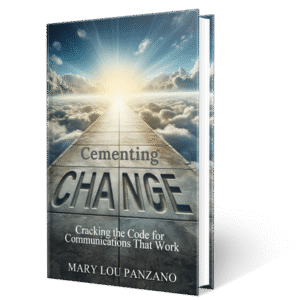 In today’s relentless world of shifting priorities and constant disruption, most organizations stumble when faced with change. Failed transformation efforts cost millions, erode trust, and leave teams overwhelmed, burnt out, and searching for answers. Why do so many change initiatives unravel, even as the stakes climb ever higher? What hidden forces sabotage progress in the shadows of the workplace?
Cementing Change: Cracking the Code for Communications That Work will be out soon.
FOREWORD
Kaveh Naficy, Partner, Lakida LLC, and Leadership Coach
Like any other label, “change” has been understood, described, experienced, and monetized in numerous ways. And the most obvious reason is that different audiences have different needs, and the author and her book are vessels to fulfill those needs.
Change is one of the most ancient and natural phenomena of our planet. After all, what doesn’t change? The rate of change, which is already mind-numbing, continues to accelerate. Consider that between the end of the 1930s and the introduction of the microchip in 1971 (the Intel 4004), transformational innovations in office technology might have included the easy correcting typewriter, the HP calculator, or the Xerox copying machines. Since then, however, the rate of change has occurred at such a dizzying pace that it is difficult to predict what the office technology will have in store for us one year hence.
So why are so many of us fearful and uneasy with it?
Most of us associate our sense of identity and worth with our vocations and careers. So, it is only natural that when discontinuous changes appear at the workplace, the primitive part of our brain starts to send fight or flight signals. We experience loss of control, confidence, competence, and comfort, which in turn lead to fear, anxiety, and stress-survivalist warnings to our bodies.
These feelings are magnified when we don’t know how to respond and take control over our lives by understanding the change, processing it, planning for it, and having the courage and support to address it appropriately.
The autonomous systems already here, such as AI that fuel faster, continuous learning and improvement, only exacerbate our sense of helplessness and loneliness.
And yet we know that the most agile, informed, and courageous will prosper most in the 21st century.
What Impedes Successful Change?
During a career spanning nearly 50 years, I have led and participated in numerous change initiatives and built the Ernst & Young European strategic change practice in the late 90s. What I witnessed was that most change methodologies and tools suffer from one or more of the following:
Why read this book?
Cementing Change addresses many of these shortcomings. The 4Cs Change Framework™—Clarity, Connection, Caring, and Courage—and the underlying 12 Principles of Prosperity provide the reader with practical language, a proven framework, and steps to understand and execute change.
Absent clarity of what is to change in language that people can understand and react to, most change initiatives will usually result in wasted effort and unfulfilling outcomes. Successful programs ensure that every person affected by the change understands clearly how it will be manifested in their workspace. Cementing Change provides the reader with the framework for ensuring clear communication of the change agenda.
When change sponsors design change programs founded on connection and caring, they allow diverse perspectives and feelings embedded in the organization to surface early in the change journey so that they can be understood, processed, and addressed. The targets of change programs are human beings who are energized and motivated when they feel heard, supported, and cared for, and NOT cogs in the wheel at the whim of the absent powerful.
Finally, leading or responding to change is fueled by courage. Those experiencing change have to be able to step into it with hope, excitement, and a sense of adventure. However, most will need more than blind faith. The fear of the unknown may well overtake their courage to experiment. They will need an infrastructure of support, tools, and practice. This book provides the ingredients for those on a change journey to shrink the risk into manageable outcomes and steps.
This book reminds us emphatically of the importance of these “softer “critical components of change leadership—listening with curiosity, empathy for others and their perspective, and supporting others while they undergo experiential learning implicit in change.
After reading the framework and concepts in Cementing Change, I have gained a better appreciation for the power of the places in which organizational and personal change intersect and the importance of applying the concepts and principles of this book at both levels.